

1. Undercut: Undercut is the groove that is smelted by the arc on the base metal at the edge of the weld.

a) Main reasons:
2. Unfused: Unfused refers to the poor fusion state between the filler metal and the base metal or between the filler metals (or not fused together).

a) The main reasons for this:
3. Overlap: Overlap refers to the metal bump formed by the molten metal flowing to the unmelted base metal outside the weld during the welding process.

a) The main reasons for this:
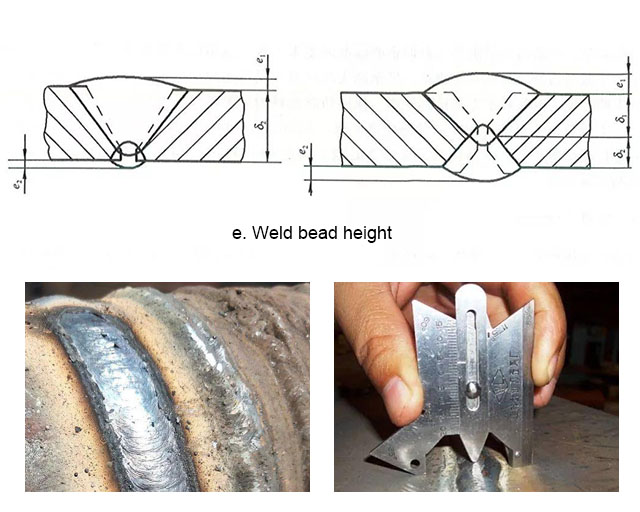
4. Too high welding seam: Too high welding seam is caused by improper welding, which makes the surface of the base metal protruding from the weld bead too high.
a) The main reasons for this:
5. Incompletely filled groove (or arc crater): Incompletely filled groove is due to insufficient filler metal, forming continuous or intermittent grooves on the surface of the weld. Arc craters are also of the same type.

a) The main reasons for this:
6. The height of the fillet weld size does not match: The height of the welding fillet does not match the main reason that the height of the welding fillet is not properly controlled during welding, resulting in too high or insufficient.

a) The main reasons for this:
7. Weld porosity: Weld porosity is the hole in the weld that the gas in the molten pool has no time to discharge and stays in the weld.

a) The main reasons for this:
8. Incomplete penetration: Incomplete penetration refers to the fact that the arc does not melt the base metal or fills the molten tungsten distinguish.

a) The main reasons for this:
9. Slag inclusion: Slag inclusion is slag, tungsten oxide, etc. remaining in the welding filler metal or in the fusion part of the base metal.

a) The main reasons for this:
10. Cracks: Cracks are the most dangerous defect in welded joints, and are also frequently encountered problems in the welding of various materials. Cracks are divided into two types: hot cracks and cold cracks according to the time of occurrence. It is a new boundary formed by the destruction of the bonding force of metal atoms in a local area in the welding speed under the combined action of welding stress and other brittle factors. It is manifested as longitudinal cracks, transverse cracks, radial cracks, crater cracks, intermittent crack groups, and dendritic cracks.

a) The main reasons for thermal cracking:
11. Burn-through: Burn-through refers to the defect that the molten metal flows out from the north of the groove during the welding process, forming a perforation defect.

a) The main reasons for this:
12. Other defects: Other defects mainly include arc scratches, splashes, surface tears, wear marks, excessive grinding, etc.
a) The main reasons for this:
c) Rework processing:

a) Main reasons:
① Use excessive welding current during welding.
② The holding angle of the electrode during welding is improper.
③ Improper speed of welding operation.
④ The welding arc is too long.
⑤ The diameter of the electrode selected for welding is inappropriate.
b) Corrective and preventive actions:
② The holding angle of the electrode during welding is improper.
③ Improper speed of welding operation.
④ The welding arc is too long.
⑤ The diameter of the electrode selected for welding is inappropriate.
① Select the appropriate current required by the process to avoid excessive current.
② The electrode angle is appropriate.
③ hen the electrode swings, it is slightly slower at the edge of the groove, and the dwell time is longer.
④ Do not pull the arc too long during operation.
⑤ Select the appropriate diameter electrode.
c ) Rework treatment:
② The electrode angle is appropriate.
③ hen the electrode swings, it is slightly slower at the edge of the groove, and the dwell time is longer.
④ Do not pull the arc too long during operation.
⑤ Select the appropriate diameter electrode.
If the undercut depth exceeds the allowable deviation, repair welding should be carried out.
2. Unfused: Unfused refers to the poor fusion state between the filler metal and the base metal or between the filler metals (or not fused together).

a) The main reasons for this:
① Welding current is too small.
② The welding speed is too fast.
③ The shape of the groove is improper.
④ There is rust on the metal surface, and the sundries have not been cleaned up.
⑤ Improper selection of electrode diameter.
⑥ The angle of the transport bar is improper during welding.
⑦ There is insufficient heat in the welding area.
b) Corrective and preventive actions:
② The welding speed is too fast.
③ The shape of the groove is improper.
④ There is rust on the metal surface, and the sundries have not been cleaned up.
⑤ Improper selection of electrode diameter.
⑥ The angle of the transport bar is improper during welding.
⑦ There is insufficient heat in the welding area.
① The welding current should be slightly larger, and the welding speed should be slowed down to increase the heat enough to melt the base metal or the previous layer of weld metal.
② The angle of the welding rod and the speed of the transporting rod are appropriate, and the temperature and melting conditions on both sides of the base metal should be taken into account.
③ The groove processing should maintain an appropriate angle.
④ Choose the appropriate electrode diameter and the electrode with good melting ability.
⑤ For the unfusion caused by slag, rust, debris, etc., the method of preventing slag inclusion can be used.
⑥ When the electrode is eccentric, the angle should be adjusted so that the arc is in the correct direction.
c) Rework treatment:
② The angle of the welding rod and the speed of the transporting rod are appropriate, and the temperature and melting conditions on both sides of the base metal should be taken into account.
③ The groove processing should maintain an appropriate angle.
④ Choose the appropriate electrode diameter and the electrode with good melting ability.
⑤ For the unfusion caused by slag, rust, debris, etc., the method of preventing slag inclusion can be used.
⑥ When the electrode is eccentric, the angle should be adjusted so that the arc is in the correct direction.
Use carbon arc gouging, air chisel, grinding, etc. to remove all defects before repairing welding.
3. Overlap: Overlap refers to the metal bump formed by the molten metal flowing to the unmelted base metal outside the weld during the welding process.

a) The main reasons for this:
① The temperature of the molten pool is too high, the liquid metal solidifies slowly, and it is attached under the action of gravity.
② Welding current is too small.
③ The angle of the electrode is not appropriate.
④ The speed and method of transporting the strips during welding are improper.
b) Corrective and preventive actions:
② Welding current is too small.
③ The angle of the electrode is not appropriate.
④ The speed and method of transporting the strips during welding are improper.
① Choose appropriate specifications, and the gap should not be too large.
② Strictly control the temperature of the molten pool to prevent it from being too high.
③ Pay attention to the speed and angle of the strip when welding.
c) Rework treatment:
② Strictly control the temperature of the molten pool to prevent it from being too high.
③ Pay attention to the speed and angle of the strip when welding.
Grind with a portable grinder.
4. Too high welding seam: Too high welding seam is caused by improper welding, which makes the surface of the base metal protruding from the weld bead too high.
a) The main reasons for this:
① Welding current is too small.
② Welding speed is too slow.
b) Corrective and preventive actions:
② Welding speed is too slow.
① Increase the welding current as much as possible within the process requirements.
② The welding speed is selected to be accelerated.
c) Rework treatment:
② The welding speed is selected to be accelerated.
Grind with a portable grinder.
5. Incompletely filled groove (or arc crater): Incompletely filled groove is due to insufficient filler metal, forming continuous or intermittent grooves on the surface of the weld. Arc craters are also of the same type.

a) The main reasons for this:
① The welding level is not well controlled.
② The welding speed is too fast.
③ The arc end of the electrode does not fill the arc crater.
b) Corrective and preventive actions:
② The welding speed is too fast.
③ The arc end of the electrode does not fill the arc crater.
① Pay attention to the control of welding level.
② Choose the appropriate shipping method and speed.
③ When the electrode ends, stay a little longer, or fill it up with intermittent arc extinguishing.
c) Rework treatment:
② Choose the appropriate shipping method and speed.
③ When the electrode ends, stay a little longer, or fill it up with intermittent arc extinguishing.
Use repair welding for treatment.
6. The height of the fillet weld size does not match: The height of the welding fillet does not match the main reason that the height of the welding fillet is not properly controlled during welding, resulting in too high or insufficient.

a) The main reasons for this:
① Inappropriate selection of electrode diameter during welding.
② The welding level control during welding is not good.
③ Improper welding speed.
b) Corrective and preventive actions:
② The welding level control during welding is not good.
③ Improper welding speed.
① Pay attention to control the welding level.
② Select the appropriate electrode diameter.
③ Pay attention to the speed of the strip when welding.
c) Rework processing:
② Select the appropriate electrode diameter.
③ Pay attention to the speed of the strip when welding.
① If the welding leg is too high, it is generally not treated. However, if the welding leg is too high, use a portable grinder to grind it.
② If the welding leg is too small, repair welding shall be carried out according to the height required by the drawings or specifications.
② If the welding leg is too small, repair welding shall be carried out according to the height required by the drawings or specifications.
7. Weld porosity: Weld porosity is the hole in the weld that the gas in the molten pool has no time to discharge and stays in the weld.

a) The main reasons for this:
① The gas generated in arc welding contains excessive hydrogen and carbon monoxide.
② The sulfur content in the base metal is too high.
③ The properties of the electrode and the baking temperature are insufficient.
④ The cooling speed of the welding part is too fast.
⑤ The welding area is caused by oil, paint, rust, galvanized layer, etc.
⑥ The air humidity is too high.
b) Corrective and preventive actions:
② The sulfur content in the base metal is too high.
③ The properties of the electrode and the baking temperature are insufficient.
④ The cooling speed of the welding part is too fast.
⑤ The welding area is caused by oil, paint, rust, galvanized layer, etc.
⑥ The air humidity is too high.
① Select the appropriate manual arc welding electrode.
② Choose the appropriate low-hydrogen electrode for baking.
③ Delay the cooling rate by means of preheating the base metal.
④ Clean up rust and debris in the welding area, and special welding rods should be used for galvanized parts.
⑤ Remove the condensation on the base metal welding area.
c) Rework processing:
② Choose the appropriate low-hydrogen electrode for baking.
③ Delay the cooling rate by means of preheating the base metal.
④ Clean up rust and debris in the welding area, and special welding rods should be used for galvanized parts.
⑤ Remove the condensation on the base metal welding area.
① The shallow depression on the surface can be repaired directly.
② Others should be polished with carbon arc gouging, air chisel or portable grinder, and then repaired after removing the pores.
② Others should be polished with carbon arc gouging, air chisel or portable grinder, and then repaired after removing the pores.
8. Incomplete penetration: Incomplete penetration refers to the fact that the arc does not melt the base metal or fills the molten tungsten distinguish.

a) The main reasons for this:
① The welding current used is too small.
② The welding speed is too fast.
③ Improper treatment of the welding root.
④ The groove processing angle is too small.
⑤ Assembly clearance is too small.
⑥ The blunt edge is too large.
b) Corrective and preventive actions:
② The welding speed is too fast.
③ Improper treatment of the welding root.
④ The groove processing angle is too small.
⑤ Assembly clearance is too small.
⑥ The blunt edge is too large.
① Increase a little current during welding.
② The welding speed should not be too fast.
③ Thorough treatment of the root of the weldment.
④ Control the angle of the welding groove.
⑤ Pay attention to control the assembly gap, and select the appropriate welding rod.
⑥ The blunt edge of the groove should not be left too thick.
c) Rework treatment:
② The welding speed should not be too fast.
③ Thorough treatment of the root of the weldment.
④ Control the angle of the welding groove.
⑤ Pay attention to control the assembly gap, and select the appropriate welding rod.
⑥ The blunt edge of the groove should not be left too thick.
The rework treatment method is the same as that of non-fusion.
9. Slag inclusion: Slag inclusion is slag, tungsten oxide, etc. remaining in the welding filler metal or in the fusion part of the base metal.

a) The main reasons for this:
① In multi-layer welding, the slag of the previous pass is contained by the subsequent welding.
② Improper welding operation.
③ Welding current is too small.
④ Use electrodes with inappropriate diameters.
⑤ The transport angle is wrong.
⑥ Improper welding speed.
⑦ The cooling rate of the base metal is too fast, so that the welding slag loses its fluidity.
b) Corrective and preventive actions:
② Improper welding operation.
③ Welding current is too small.
④ Use electrodes with inappropriate diameters.
⑤ The transport angle is wrong.
⑥ Improper welding speed.
⑦ The cooling rate of the base metal is too fast, so that the welding slag loses its fluidity.
① The previous welding slag should be cleaned up.
② The welding slag and molten iron should be distinguished during welding.
③ Properly increase the welding current.
④ Choose electrodes of suitable diameter.
⑤ Pay attention to control the angle of transport.
⑥ Appropriately slow down the welding speed.
⑦ Preheat the welding area.
c) Rework treatment:
② The welding slag and molten iron should be distinguished during welding.
③ Properly increase the welding current.
④ Choose electrodes of suitable diameter.
⑤ Pay attention to control the angle of transport.
⑥ Appropriately slow down the welding speed.
⑦ Preheat the welding area.
The method of rework treatment is the same as that of unfused treatment.
10. Cracks: Cracks are the most dangerous defect in welded joints, and are also frequently encountered problems in the welding of various materials. Cracks are divided into two types: hot cracks and cold cracks according to the time of occurrence. It is a new boundary formed by the destruction of the bonding force of metal atoms in a local area in the welding speed under the combined action of welding stress and other brittle factors. It is manifested as longitudinal cracks, transverse cracks, radial cracks, crater cracks, intermittent crack groups, and dendritic cracks.

a) The main reasons for thermal cracking:
① The quality of the electrode is unqualified (insufficient manganese content, high carbon and sulfur content).
② It is caused by accidentally adding more than a certain amount of copper into the weld.
③ When welding at the welding part with high rigidity, the arc ending is too fast, resulting in arc crater.
b) Corrective and preventive actions:
② It is caused by accidentally adding more than a certain amount of copper into the weld.
③ When welding at the welding part with high rigidity, the arc ending is too fast, resulting in arc crater.
① A qualified electrode produced by a qualified manufacturer should be used.
② should find the source of copper, try to remove.
③ Improve the arc ending operation technology, fill the arc crater and then end the arc.
c) The main reasons for cold cracks:
② should find the source of copper, try to remove.
③ Improve the arc ending operation technology, fill the arc crater and then end the arc.
① The hydrogen content in the weld metal is too large.
② The carbon content of the base metal is too high and the cooling rate is fast, which causes the hardening of the welded area.
③ The thickness of the base metal is too large and the rigidity of the welding zone is large, or the improper operation sequence produces large internal stress.
d) Corrective and preventive actions:
② The carbon content of the base metal is too high and the cooling rate is fast, which causes the hardening of the welded area.
③ The thickness of the base metal is too large and the rigidity of the welding zone is large, or the improper operation sequence produces large internal stress.
① Use a low hydrogen type electrode.
② The electrode should be baked and dried, and the welding area should be cleaned of oil and debris.
③ Take the correct welding sequence.
④ Relieve stress and dehydrogenation by means of preheating, heat preservation and post-weld treatment.
e) Rework treatment:
② The electrode should be baked and dried, and the welding area should be cleaned of oil and debris.
③ Take the correct welding sequence.
④ Relieve stress and dehydrogenation by means of preheating, heat preservation and post-weld treatment.
Cracks may extend, so all the places with cracks must be removed, and the extension of 50 mm at both ends is also removed. Before repairing, the cause of the crack should be clarified, the rework welding process should be formulated, and preventive measures should be put forward before repairing.
11. Burn-through: Burn-through refers to the defect that the molten metal flows out from the north of the groove during the welding process, forming a perforation defect.

a) The main reasons for this:
① The welding current is too large and the heat is concentrated.
② The diameter of the selected electrode is too large.
③ The assembly gap is too large.
b) Corrective and preventive actions:
② The diameter of the selected electrode is too large.
③ The assembly gap is too large.
① Appropriately reduce the welding current, and pay attention to the speed and method of the strip.
② Select the electrode according to the thickness of the weldment.
③ Pay attention to the assembly clearance.
c) Rework treatment:
② Select the electrode according to the thickness of the weldment.
③ Pay attention to the assembly clearance.
Use a portable grinder or carbon arc gouging to remove burn-through residues and defects before performing repair welding.
12. Other defects: Other defects mainly include arc scratches, splashes, surface tears, wear marks, excessive grinding, etc.
a) The main reasons for this:
① Arc ignition outside the weld groove is caused by local damage on the metal surface of the base metal.
② The molten metal particles and slag scatter to the base metal and adhere to the weld area of the base metal are not removed in time according to the operating procedures.
③ If the temporary welding accessories are not removed according to the operation rules, the surface damage of the base metal will occur.
④ Local surface damage caused by grinding not in accordance with the operating procedures.
⑤ Do not use a flat shovel or other tools to shovel metal and cause local damage.
⑥ Allowable thinning of components or welds due to grinding.
b) Corrective and preventive actions:
② The molten metal particles and slag scatter to the base metal and adhere to the weld area of the base metal are not removed in time according to the operating procedures.
③ If the temporary welding accessories are not removed according to the operation rules, the surface damage of the base metal will occur.
④ Local surface damage caused by grinding not in accordance with the operating procedures.
⑤ Do not use a flat shovel or other tools to shovel metal and cause local damage.
⑥ Allowable thinning of components or welds due to grinding.
① Strengthen the education and inspection of welding operation rules.
② When welding, choose the dried electrode, pay attention to the current polarity, current size and electrode type.
③ Welding and post-welding treatment shall be carried out in strict accordance with the operating procedures.
② When welding, choose the dried electrode, pay attention to the current polarity, current size and electrode type.
③ Welding and post-welding treatment shall be carried out in strict accordance with the operating procedures.
c) Rework processing:
① Arc scratches should be polished clean, and the arc depth should be polished after repair welding.
② Clean up the splash in time.
③ If the ground surface is torn and lower than the base metal, it should be ground after repair welding.
④ Surface damage exceeding the allowable deviation is repaired by welding and grinding.
⑤ The damaged parts should be ground, and those exceeding the allowable deviation should be repaired and ground after grinding.
⑥ Excessive grinding should be repaired after welding.
② Clean up the splash in time.
③ If the ground surface is torn and lower than the base metal, it should be ground after repair welding.
④ Surface damage exceeding the allowable deviation is repaired by welding and grinding.
⑤ The damaged parts should be ground, and those exceeding the allowable deviation should be repaired and ground after grinding.
⑥ Excessive grinding should be repaired after welding.


